
Righteousness Repeated
Virginia Leads the Way

George Kennan, one of the titans of 20th century American diplomacy, appeared in April, 1951 at the University of Chicago to present a series of lectures. He was there to explain, more or less, the first half of the 20th century.
“In the fabric of human events,” Kennan said, “one thing leads to another.”
Last week, in the after aftermath of Jim Ryan’s resignation as president of the University of Virginia, The Cavalier Daily reported the comments of 2024 alumna Taylor Vest, who said that Ryan’s resignation was not only an attack on the University, but on academic freedom and institutional independence. She fingered the Board of Visitors as one culprit.
“Rather than defend our University’s leadership and autonomy, they have stood by while a respected president is pushed out for staying true to his convictions which benefit the greater university community,” Vest said. “This is not how decisions should be made at U.Va. This is not how leaders are treated in a healthy democracy. This is not the Virginia way.”
She’s right. This is not the Virginia Way.
President Donald Trump has no slot in the chain of command. An institutional process determines and controls the leadership of Virginia’s schools. Wedging the president in there, via his righteous Justice Department, is neither constructive nor sensible.
But, as Kennan said (hard to argue with it), one thing does tend to lead to another and it often seems as if humanity suffers for lack of imagination. Where might matters take us next?
Just two years ago, the Supreme Court ruled race-conscious admissions policies in higher education violated the U.S. Constitution. While the ruling itself was limited to college admissions, its reasoning has rapidly become a basis for legal and political challenges to Diversity, Equity, and Inclusion (DEI) initiatives in other settings.
In effect, the Supreme Court affirmed the Equal Protection Clause as a “foundational principle,” excluded race-based decision-making and that, for the time being, is that.
This has implications, not just for the University of Virginia, but for every state-owned college and university in the commonwealth. That fact may now be sinking in.
I’m not saying “resistance is futile,” but if the Democrats win back the governor’s office this fall and retain their majority in the House of Delegates and Virginia Senate, they may be tempted to reinstall the campus racial equity structures that the Trump administration now has in its sights.
Should that be in their minds – they have publicly said as much -- the Democrats may wish to calculate what may follow. Just because things are bad doesn’t mean they can’t get a lot worse.
In that regard, it’s worth noting that Virginia’s governing arrangements, specifically pertaining to higher education, have been increasingly abused and seemingly without any appreciation of how that practice travels a two-way political street.
In effect, by violating long-standing principles, established to protect governing institutions, including Virginia’s colleges and universities, we effectively opened the door to the worst kind of political shenanigans.
Are Virginians oblivious to what’s been happening in recent years?
In 2020, for instance, hardly anyone objected when Gov. Ralph Northam and his party stalwarts – meaning the Democratic Party leadership of the General Assembly – rudely abandoned established procedure and pressured retired Army Gen. Binford Peay to resign as superintendent of Virginia Military Institute.
That wasn’t remotely kosher and the Democrats knew it at the time. Gov. Northam presented it (rationalized it) as righteous work.
In truth, it stunk to high heaven.
However, if you accept that “one thing leads to another,” you don’t start with Northam’s assault on VMI in the fall of 2020. Instead, you pick up the action from a year before, on Friday, February 1, 2019, when the world fell in on Ralph Northam following a posting of his 35-year-old medical yearbook page on the Internet.
Suddenly Democrats all over America – including many Virginia Democrats who Northam considered to be his friends and allies – pointed to two unidentified people in racial garb and declared that Northam should no longer be governor.
Everyone moved fast, too, because no one wanted to be left on the wrong side of history. That was clearly the great worry.
The people denouncing Northam grew so numerous, so quickly that NBC’s “Meet The Press” program took to scrolling all their names. Many pols, many journalists, were certain Gov. Northam would not survive.
There was just one problem: The 2017 state election made Ralph Northam governor and all the righteous clamor – the yelping mob -- counted for nothing.
Elections matter. Period. So, Ralph Northam stood his ground, finished his full term of office and was correct to do so. He protected an ancient and vital Virginia office from a political stampede. He did the right thing.
Unfortunately, the following year, in 2020, Ralph Northam galumphed off in the other direction.
Motivated by nothing more than specious articles in a spectacularly specious newspaper -- The Washington Post – Northam unleashed the Kraken on VMI. It looked thus:
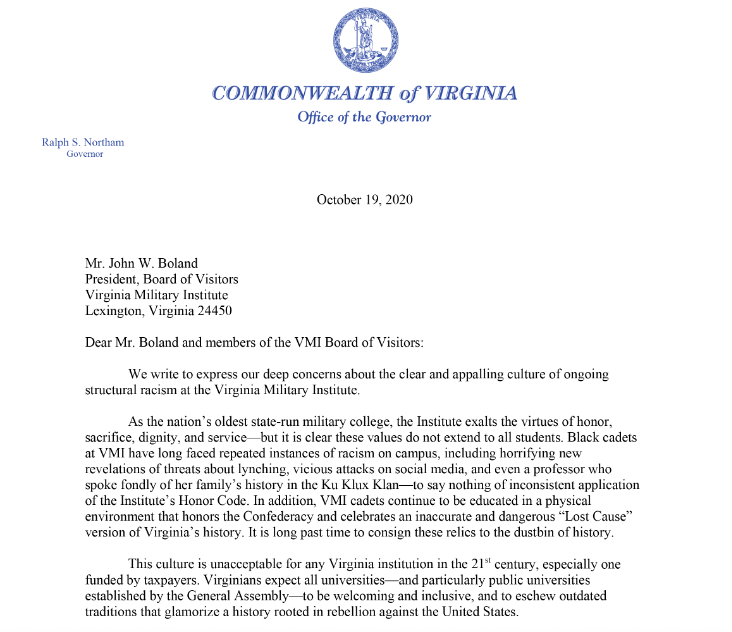
That’s just an excerpt of the first page. It goes on like that and it’s all rather judgmental.
Conjure up all the bogus historical references you like, this was a blatant political attack, as raw and as “dangerous” as they come. Northam and his merry band of lawmakers had made up their minds before the investigation was even begun.
How do we know that? Because the letter said so. The letter condemned the school in clear terms and then authorized a $1 million taxpayer-funded investigation in order to justify the condemnation.
Why do this? Northam led the charge. Was he suddenly taken by the moral imperative of achieving a finer, more just Virginia?
Or was he blitzed by the prior year’s near-death (politically-speaking) experience and resolved to make common cause with a Virginia Democratic Party that had lurched to the left following the 2017 and 2019 state elections.
(Yes, you’re right, if we’re doing “one-thing-leads-to-another” the true precipitating event in all this was Donald Trump’s ’s 2016 election to the White House and the reaction within Virginia.)
About Northam specifically: Who would risk a guess at his mental state? Like the rest of the human race, Northam’s motives could well be described as complicated and multitudinous.
Still, within a week of his yearbook page’s reemergence, Northam began sounding and acting like a God-fearing, drum-beating progressive, an orientation that no one – I mean, no one -- would have tagged him with previously.
A mere four months after the yearbook fiasco, on June 4, 2019, Gov. Northam signed an executive order and established the Governor’s Commission to Examine Racial Equity.
Read the Commission’s final report and examine its recommendations. It’s readily available on-line. It was definitely not meant to be shelved and ignored.
Nor was the Commission itself meant to ever end its work.
“Vast swaths of Virginia’s policies have yet to be investigated or considered through an equity lens, and the Commission is aware that the work must continue, particularly as the Commonwealth commits to better data collection on many topics,” the Commission reported in November, 2020.
“It is therefore recommended that the legislature officially codify the Commission’s existence as a permanent Advisory Commission, as defined in §2.2-2100, to outlast any single administration.”
Likewise, the commission called upon Virginia to “enact a process that would require examination of proposed legislation with an equity lens.”
That’s all proposed Virginia legislation. Every bill — all of them — would be subjected to a racial analogue of a fiscal impact statement.
Should you think this is all behind us, think again.
Better, go back go back to the letter sent to VMI. You will notice that it wasn’t just the work of Gov. Ralph Northam. Take a look at the signature page.
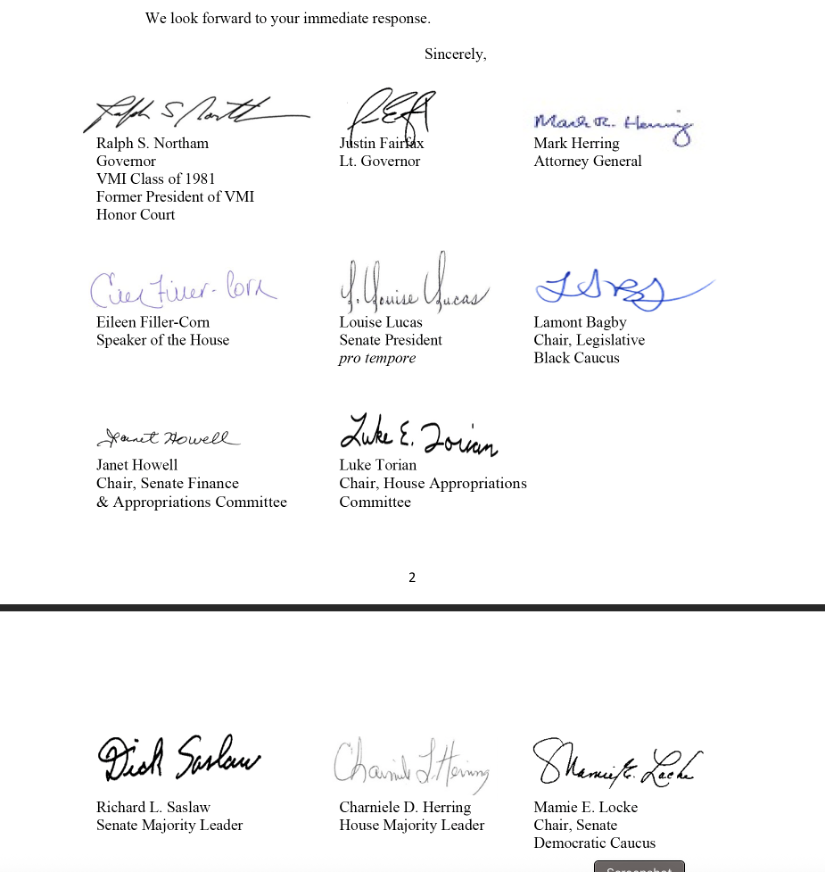
No letter like this – not one, not ever – previously escaped the Virginia Governor’s Office. Official acts require the governor’s signature alone. Why did these other people – all elected state officials, all Democrats – sign it as well? What was the point?
To put on a show. To do a dance. To dramatize a political act with inflammatory and noxious language.
Some of Virginia’s leading legislative lights took it further. Del. Mark Levine (D-Alexandria) called for defunding VMI.
Sen. Janet Howell, (D-Fairfax), who then chaired the Virginia Senate Finance Committee, said that, failing rapid change at VMI, she would consider reducing the school’s state support.
In sum, Virginia Democrats decided to pressure the school’s leadership, compromise the governing board’s prerogatives, demand a fast, comprehensive response and threaten defunding.
President Trump could not ask for a more righteous roadmap. He came after UVA the exact same way.
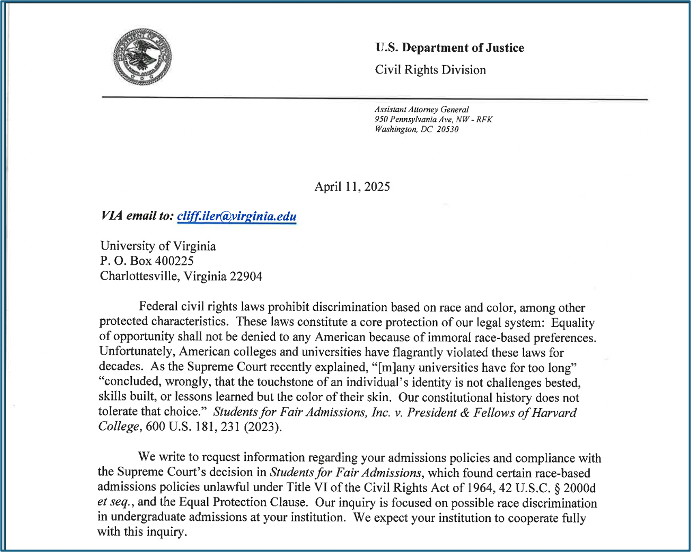
The difference between Virginia’s approach to VMI in 2020 and Washington, D.C.’ s approach to UVA 2025? Qualitatively, very little.
We certainly have the righteous part down pat. And we’ve learned to ignore established procedures, process and governing principles when there’s an “emergency.”
We just declare that the old rules no longer apply. Trump does it every day. Virginians illuminated the path forward.
Accurate, even if it leaves a bitter taste. The UVA BOV ducked, but maybe other boards have followed the same strategy in the past. The ultimate fear: Ken the Cuch is named next president of UVA!